
A commercial sound system is audio built for a room that has a job to do. Department stores, restaurants, sports bars, hotels, corporate headquarters. The engineering problem is the same in all of them: deliver even, intelligible sound across a large space where people are moving, talking and doing business.
That is harder than it sounds. A room with hard floors and glass walls behaves nothing like a carpeted lobby. Get the speaker count, placement and zoning wrong and you end up with dead spots in one corner and a wall of noise in another. This guide covers what goes into a commercial sound system, what it costs and how to judge whether a proposal you have been handed is any good.
SEE ALSO: Should Your Architect Be Picking Out Your Technology for New Builds?
How commercial sound systems work
Signal flows in one direction. A source, a microphone, a music player or a paging station, feeds a mixer. The mixer sets levels and tone, then passes the signal to an amplifier. The amplifier raises it to the power the speakers need and the speakers put it into the room.
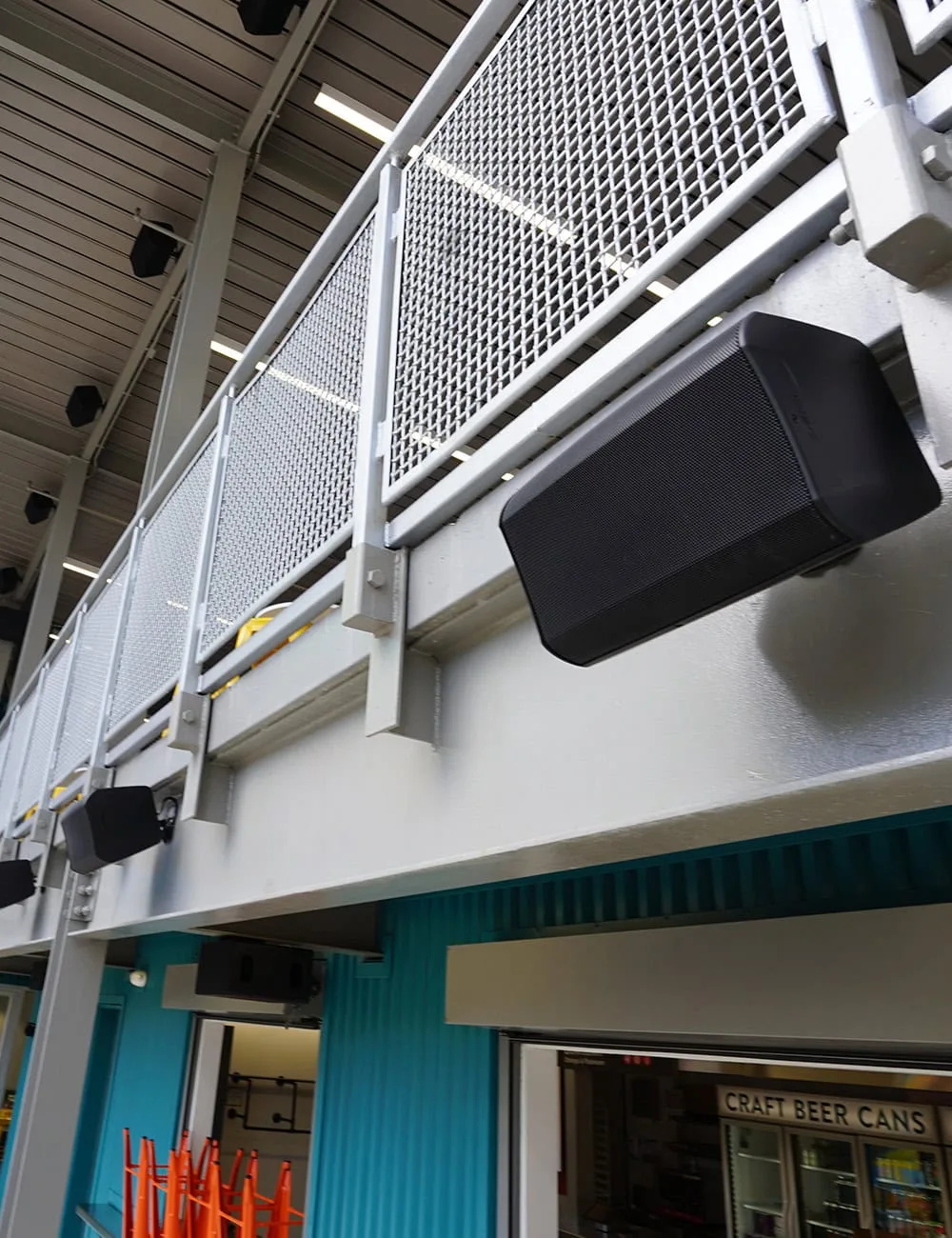
A well-designed system gives you control over level, tone and volume in each area, which is what keeps the sound usable rather than merely loud. Most commercial buildings run ceiling speakers because they spread background music and announcements evenly without drawing attention to themselves. Wall-mounted speakers get used where ceiling height or construction makes that impractical.
Components of a commercial audio system
Six parts do the work:
- Mixer. The control point. It sets the level of each input, adjusts tone and routes audio to the right zones before anything reaches the amplifier.
- Amplifier. Takes the mixer's output and raises it to the power the speakers require. Commercial amplifiers run multiple speakers at once and are built for continuous duty, which is why they outlast consumer gear in a venue that opens seven days a week.
- Speakers. Ceiling speakers carry background music and announcements. Wall-mounted and surface speakers cover larger or taller spaces where ceiling coverage cannot reach.
- Subwoofers. Only needed where low frequency matters. A club or an event hall wants them. A cafe almost never does.
- Cabling and mounting hardware. The unglamorous half of the install. Cable runs carry signal and power between components and proper mounting keeps speakers secure and visually unobtrusive.
- DSP. Digital signal processing handles equalisation, compression, delay and feedback suppression in real time. It is what makes one system sound tuned to its room instead of generic.
Together these produce consistent audio for speech, background music and live performance across a commercial space.
Selecting the right speakers
Coverage depends more on placement than on the speaker itself. Ceiling speakers save wall space and spread sound evenly downward, which suits open-plan retail and offices. Wall-mounted speakers project further and work better in rooms with high ceilings or exposed structure. Acoustics decide which one belongs where.
| Aspect | Ceiling Speakers | Wall-Mounted Speakers |
|---|---|---|
| Space Utilization | Excellent - Preserves floor/wall space | Moderate - Requires wall space |
| Sound Coverage | 360° dispersal pattern, ideal for open areas | Directional coverage, good for specific zones |
| Best Use Cases | Open offices, retail spaces, restaurants | Theaters, presentation rooms, corridors |
| Installation Complexity | Higher - Requires above-ceiling access | Lower - Direct wall mounting |
| Acoustic Performance | Better for uniform coverage in large spaces | Better for targeted sound projection |
| Visual Impact | Minimal - Blends with ceiling | More visible - Part of wall architecture |
The importance of the amplifier
The amplifier supplies the power. Specify one with multiple channels and you can drive each zone independently. That is what lets a single system run quiet music in a dining room and louder coverage on a patio at the same time.
Balancing acoustics
Construction materials absorb and reflect sound and that changes what the room does to your audio before anyone hears it. Hard surfaces bounce sound and blur speech. Soft surfaces absorb it. Adding acoustic treatment where the reflections are worst does more for intelligibility than adding speakers and it usually costs less.
Coverage and zoning
Zoning is how one system serves rooms with different needs. Divide the space into independently controlled areas and each one gets the level and content it actually requires.
Speaker placement for even distribution
Placement decides whether a guest hears the same thing standing at the counter and sitting by the window. In a cafe, ceiling speakers spaced for even coverage let customers hear music without it cutting across conversation. Divide that same room into zones and you can run the order counter louder to carry over noise while the seating area stays soft enough to talk in.
Effective zoning strategies
Multi-purpose venues get the most out of zoning. A multi-channel amplifier lets you set volume and content separately in each area. A hotel lobby can run quiet background music while the gym two floors up runs something with more energy, on the same system. The result is a room that suits the people in it rather than one compromise level everywhere.
Building a commercial audio system package
Start with the space, then work backwards to the equipment. Measure the areas, count the zones and establish what each one is for. A system covering background music and paging typically needs a multi-zone amplifier, a mixer with enough inputs for your sources and a mix of ceiling and wall-mounted speakers.
Cost expectations
Price tracks zone count and component quality more than it tracks square footage. The three tiers below are what we see most often.
| Tier | Best for | What it includes | Price range |
|---|---|---|---|
| Basic | Cafes, boutique retail, small office receptions | Single-zone system, basic ceiling speakers, straightforward stereo amplifier. Clear background music and announcements without extensive inputs or acoustic tuning. | $500 to $2,500 |
| Mid-tier | Restaurants, medium event spaces, small hotels | Multi-zone amplifier, better speaker placement and mounting, a mixer with multiple input sources. Higher sound quality and independent zones. | $2,500 to $10,000 |
| Premium | Large auditoriums, nightclubs, luxury hotels | Top-tier amplifiers driving a larger speaker network, additional mixers for extensive inputs, custom acoustic treatment tuned to the room. | Starting at $10,000, can exceed $30,000 |
Those ranges cover equipment and installation for a typical room of that type. A venue with difficult acoustics, long cable runs or a listed building to work around will sit at the upper end.
Commercial sound systems we recommend
The hardware matters as much as the design. These are the manufacturers we specify most often and why.
1. QSC [View Brand]
QSC components hold up under continuous commercial duty. Amplifiers, mixers and speakers across one range, which keeps a system consistent when it grows.
2. Biamp [View Brand]
Biamp's strength is signal processing. Their platforms hold speech intelligible in rooms that fight back, from small conference rooms to large auditoria.
3. Bose [View Brand]
Bose Professional builds compact enclosures that disappear into a finished space, which matters where the ceiling is part of the design and a visible box is not acceptable.
4. Crestron [View Brand]
Crestron is the control layer. Their interfaces put audio, video and lighting behind one panel a manager can actually operate on a busy shift.
5. Extron [View Brand]
Extron builds the connective hardware: amplifiers, mixers and signal processors designed to be installed and serviced quickly, which shortens both the install and every future call-out.
6. JBL [View Brand]
JBL Commercial covers a wide range of professional environments and holds up in rooms that run loud for long hours.
7. Electro-Voice [View Brand]
Electro-Voice speakers, amplifiers and microphones have a long track record in sound reinforcement, where both speech and music have to carry.
8. Atlona [View Brand]
Atlona, now part of Hall Research, handles audio and video connectivity. Useful where sound is one part of a larger distribution system rather than a standalone install.
Types of commercial audio systems
Outdoor speakers
Outdoor systems are built to survive weather. Weatherproof enclosures and corrosion-resistant hardware keep a patio, theme park or sports arena running through rain and heat that would kill indoor gear in a season. They also have to project further, because there are no walls to reflect sound back.
Indoor vs outdoor sound systems
The priorities invert. Outdoors, durability and projection come first. Indoors, acoustics and appearance do: a hotel lobby needs sound that is clearly audible and equipment nobody notices.
| Feature | Indoor Sound Systems | Outdoor Sound Systems |
|---|---|---|
| Primary Focus | Acoustics and aesthetics | Durability and weather resistance |
| Design Priority | Clear sound reproduction, discreet placement | Weather protection, sound projection |
| Hardware Integration | Seamless with interior design | Ruggedized, weatherproof construction |
| Installation Considerations | Advanced acoustical design, hidden wiring | Weather sealing, moisture protection |
| Environment Challenges | Room resonance, reflection control | Weather exposure, sound dispersion |
| Aesthetic Requirements | Blend with interior decor | Functional durability over appearance |
| Sound Quality Factors | Room acoustics optimization, controlled environment | Environmental noise compensation |
Ceiling speaker systems
Most indoor commercial spaces run 70-volt ceiling systems. The 70-volt design lets many speakers share one amplifier over long cable runs without losing level, which is why it suits retail floors, corporate offices and hospitality spaces where coverage matters more than output.
PA (public address) systems
Transport hubs, schools and hospitals depend on PA for announcements and emergency communication. Microphones, amplifiers and loudspeakers, specified so that a message stays intelligible to a large crowd in a space that was never designed for speech.
Installation and maintenance
Planning decides how long the system lasts. Certified installers matter here because the work is as much about integrating with existing infrastructure as it is about hanging speakers. Conduit routing, device placement and cable management determine both how it sounds and how it looks when the ceiling tiles go back.
After that, maintenance keeps it working. Scheduled cable inspection, firmware updates on the digital components and periodic testing catch faults while they are still small. A venue on a maintenance plan replaces a failing amplifier on a Tuesday morning. A venue without one finds out on a Friday night.
Commercial sound system integration
Audio rarely stands alone any more. Tie the sound system to digital signage and a promotion runs on screen and over speakers at the same moment. In a retail floor or an event space that is worth more than either channel alone.
Networked systems add central control, so one interface manages every zone in the building. Where a venue already runs smart building controls, the audio can respond to occupancy or time of day automatically and conference spaces can tie into voice-activated meeting systems.
New technologies for commercial sound
Beamforming is the most useful recent development. It steers output to where listeners actually are, which raises clarity in the target area and reduces spill everywhere else. Alongside it, digital signal processing has improved enough to correct level and clarity in real time and AI-assisted systems are beginning to adjust to how a room is being used. Wireless and IoT connectivity have made installation simpler and allow remote monitoring, so faults surface before a customer notices them.
2024 to 2025 developments
Three worth knowing about:
1. Directional sound. Audfly showed its screen-based Focusound Screen at CES 2025, a film-based directional system that turns a display into the speaker. It focuses audio to one listener, which protects privacy and cuts noise in shared spaces. Audfly also announced the technology integrated into Lenovo's ThinkCentre M90a Pro Gen 6.
Source: audioXpress
2. AI-assisted audio processing. Elgato's Wave Link 2.0, released in early 2025, uses voice processing developed by AIcoustics. Its Voice Focus feature suppresses background noise and adapts to different acoustic conditions.
Source: The Verge
3. Immersive audio at scale. Sphere Immersive Sound runs on Holoplot's X1 Matrix Array, delivering consistent level and spatial audio to every seat in a venue that size. The engineering behind it points at where large-venue commercial audio goes next.
Source: the Sphere
Choosing an AV company for consultation and installation
The specification is worth more than the shopping list. Any integrator can quote equipment. The value is in whoever works out how many zones your space needs, where the speakers go and what the room will do to the sound once it is full of people.
We start with a consultation about how the space is actually used, then design around that. Installation is planned to keep a trading venue trading and we stay on afterwards for support, because a sound system is only as good as its worst week.
Install a new commercial audio system
Sound shapes how a space feels and whether people can communicate in it. Done properly, it is infrastructure, in the same category as lighting and HVAC. Talk to us about what your space needs and we will design a system around it.