By Adi Khanna | CEO, Crunchy Tech
We don’t sell you what we have. We design what you need.
That line is the operating principle I’ve built Crunchy Tech around for the last 20 years. And it’s the single sentence that separates us – and the small handful of firms like us – from the other 97% of the commercial AV industry.
Here’s what I mean: most AV companies operate on one of two models. The first is the order-taker: you point, they mount. A TV on a wall and speakers in the ceiling. No strategy or design. Neither is there accountability for whether any of it does anything for your business.
The second is the product-pusher: they show up with a spec sheet, recommend the most expensive gear they carry, overengineer the system by 40%, and then leave you with a room that costs too much and does too little.
There are maybe 3% of AV companies in the US that operate on a third model; one where the first question isn’t “what equipment do you want?” but “what does this space need to accomplish for your organization?” That question changes everything downstream. It changes what gets designed and what gets built, as well as how it gets supported and whether the investment ever earns a return.
That third model is Design-Build. And this piece is about what it means exactly, its importance, and how to know if your AV partner operates this way.
TL;DR
- The 3% rule: Only a small fraction of AV companies design around business outcomes instead of equipment. Crunchy Tech is one of them.
- Meaningful outcomes defined: Revenue lift, operational efficiency, guest/employee experience, and financial performance – every project is measured against all four.
- Four design lenses: Marketing/brand expression, operations/staff usability, experience design, and owner financial performance. A lot of AV companies think through zero of these.
- Phase 1 buys clarity, Phase 2 buys certainty: A two-phase process that de-risks the investment by showing you the design before you commit to the build.
- The buyer’s checklist: Six questions that separate the top 3% from the other 97%. If your AV partner can’t answer yes to all six, you’re working not with a partner but with a vendor.
What “Meaningful Outcomes” Actually Means
I use this phrase constantly inside Crunchy Tech, and I want to define it precisely – because it’s not a marketing abstraction.
A meaningful outcome is a measurable business result that the AV system was intentionally designed to produce. Not “we installed 40 TVs.” That’s an output.
A meaningful outcome is: “We designed a sightline strategy that puts every seat in the house within comfortable viewing distance of at least two screens, supported by multi-zone audio that lets the bar run at game-day energy while the dining room stays ambient – and the staff can shift between modes in one tap.”
The difference is accountability. An output is something you deliver, whereas an outcome is something you’re responsible for.
In our experience across 30+ cities and over 3,000 projects, meaningful outcomes fall into four categories. Every project we take on gets evaluated against all four.
1. Revenue outcomes
Does the AV system directly contribute to the venue’s ability to generate revenue? In hospitality, that means digital signage that lifts featured-item sales, sightlines that increase dwell time, and atmosphere that brings guests back.
Research consistently shows the impact is real: restaurants using well-designed digital menu systems report sales lifts of 86% on promoted items, and immersive environment design extends average dwell time per visit.
2. Operational outcomes
Does the system make the staff’s job easier or harder? Can the bartender change game-day scenes in one tap? Can the hotel events team configure a ballroom for three different clients in one day without calling IT? Does the conference room work the first time every time for every platform?
If the AV creates operational friction instead of reducing it, it’s failing; no matter how impressive the spec sheet looks.
3. Experience outcomes
Does the space feel right? Does the restaurant sound like a place you want to stay? Does the corporate lobby communicate competence? Does the sports bar feel electric on game day?
According to OpenTable’s 2026 research, 40% of diners say atmosphere is as important as food when choosing a restaurant. The experience IS the product; and AV is the infrastructure that delivers it.
4. Productivity outcomes
For enterprise environments, does the conference room eliminate the 20% tax – the 15% of meeting time lost to AV friction? Does every room work the same way across every office? Can IT manage 200 rooms from a single dashboard?
Productivity outcomes are where enterprise AV earns its return.
The Four Lenses We Design Through
Every Crunchy Tech project goes through four simultaneous design lenses. This is the part that separates Design-Build from everything else because most AV companies only think through one lens, if they think through any.
1. Marketing / brand expression
What does this space say about the brand? The screens, the digital signage, the lighting, the content. They’re all telling a story to every person who walks in.
Is that story intentional? Or is it whatever the AV installer decided to put up on opening day? We design the AV to express the brand the way the owner intended, which is as a strategic layer of the physical environment.
2. Operations / staff usability
Can the people who actually run this space operate the system under real conditions?
Not during a demo or when the AV programmer is standing behind them – on a Tuesday night with a new hire behind the bar and 200 guests walking in for trivia night. If the system requires the owner to be on-site for it to function, it’s a dependency.
3. Guest (or employee) experience
Does the room deliver the emotional and functional experience it was designed for? Does the sports bar feel immersive? Does the hotel ballroom adapt to the event? Does the conference room make remote participants feel like they’re in the room?
Experience design is what turns square footage into a destination.
4. Owner / business financial performance
Does the math work? Is the system right-sized, meaning it’s neither overbuilt for the demo nor underbuilt for the peak day? Does it deliver measurable return through revenue lift, operational efficiency, guest retention, or productivity gains?
The financial lens is the one that keeps the other three honest.
Why the Rest of the Industry Can’t Match This
It all boils down to structural analysis. The commercial audio and visual industry is organized around two models that are fundamentally incompatible with outcome-based design.
Big-box AV providers are optimized for contracts.
They win large-enterprise deals on procurement efficiency and brand recognition. They standardize on a narrow set of certified hardware. They install at scale but their economic model depends on throughput – move crews in, complete the install, move crews out.
There’s no incentive to spend 40 hours on sightline analysis or to design game-day scenes for a sports bar. The margin isn’t in the design but in the volume. So the design doesn’t happen.
Small shops are optimized for boxes.
A two-person AV company can hang TVs beautifully. They know their gear and are undoubtedly reliable on small jobs. But they don’t have the engineering depth to design multi-zone audio systems, the programming bench to build scene-based control, the logistics to deploy across 15 states, etc.
They’re craftsmen; and I respect that. But the gap between craft and consultative business-outcome design is enormous.
The Design-Build model requires scale, depth, and a fundamentally different business structure.
You need engineers who think about sightlines, programmers who think about staff workflows, project managers who coordinate with architects and GCs, and support teams who monitor systems remotely and show up on Saturday night when something breaks.
You need 300+ people across 32 cities who all operate to the same standard. That’s not something you assemble from a product catalog. That’s something you build over 20 years.
The Design-Build Process, Phase by Phase
Here’s how it actually works – the process behind the philosophy.
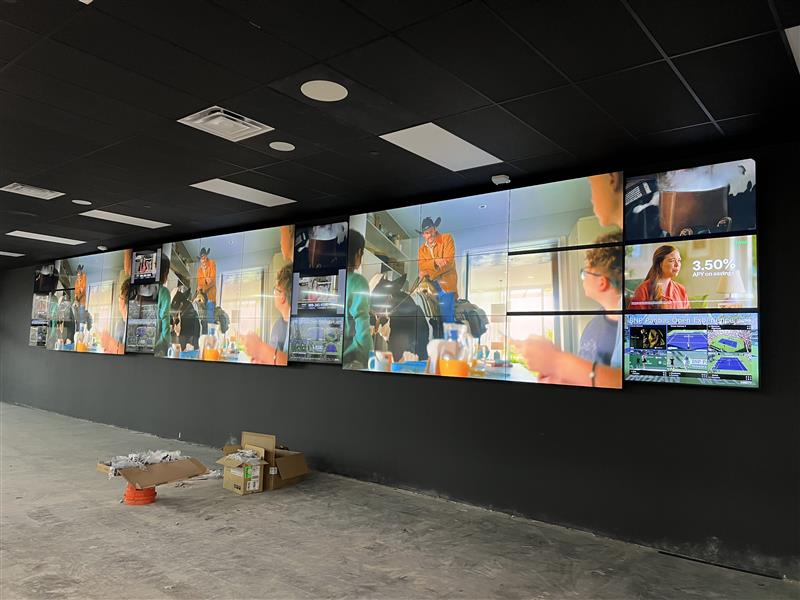
Phase 1: Clarity
Phase 1 is paid discovery. We spend the time to understand the business – its goals, operations, peak days, staff capabilities, budget reality, and so on. We walk the space, map sightlines, analyze acoustics, and interview operators.
The deliverable is a design package that shows the client exactly what the system will do, how it will look, and what it will cost before a single piece of equipment is purchased. Phase 1 buys clarity.
Phase 2: Certainty
Phase 2 is execution. Engineering, procurement, installation, programming, commissioning, training, and go-live support. One team owns every phase. No handoffs between a design firm and an install crew. No finger-pointing between the consultant and the integrator.
If something isn’t right, there’s one phone number to call and one team accountable for the fix. Phase 2 buys certainty.
According to the Design-Build Institute of America, Design-Build project delivery results in 102% faster project completion compared to traditional design-bid-build. And that data comes from the construction industry at large, not just AV.
The principle holds across disciplines: when one team owns the outcome from design through delivery, the project is faster, cheaper, and better.
What Changes When You Design for Outcomes
Let me give you three scenarios (all real, all projects we’ve delivered).
The sports bar that flexes between $3K and $200K days
The AV system has 60+ displays on AVoIP distribution, multi-zone audio with six independent zones, and scene-based control that lets a bartender transform the room from Tuesday lunch to NFL Sunday in one tap. On game day, every seat has a sightline. Every zone has the right audio.
The system doesn’t care whether there are 40 people or 400. It was designed for both. That’s outcome-based design.
The conference room that just works
Platform-agnostic. One button to start. Camera auto-frames. Audio DSP manages microphone zones automatically. Remote participants hear every voice, see every face, and read the whiteboard. IT manages 40 rooms from a single dashboard. The CFO walks in with three minutes before her call, presses one button, and the room is live.
That’s what meeting productivity looks like when the AV was designed for it.
The hotel lobby that became a revenue driver
Digital signage tied to the property management system – dynamic content that shifts by daypart, event type, and guest profile. Ambient audio zones that create a sense of arrival. Low voltage lighting integrated with the AV control layer for seamless atmosphere shifts between morning coffee, afternoon meetings, and evening cocktails.
The lobby went from a pass-through space to a revenue-generating venue.
That’s meaningful outcomes.
How to Know If Your AV Partner Operates This Way
This is the buyer’s checklist. Before you sign, ask these questions.
- Do they ask about your business before they talk about technology?
- Do they present options with clear tradeoffs (value, balanced, and premium), instead of one take-it-or-leave-it proposal?
- Is the design team the same as the install team – one accountability chain, no handoffs?
- Do they offer a phased process where you see the design before you commit to the build?
- Do they provide ongoing managed support or does the relationship end at commissioning?
- Can they show you projects in your industry, at your scale, with measurable outcomes?
If the answer to all six is yes, you’re probably talking to someone in the top 3%. If the answer to more than one is no, you’re talking to the other 97%.
According to AVIXA, the commercial AV industry is increasingly shifting from transactional installations to long-term, service-based partnerships; it’s a trend that validates the Design-Build model Crunchy Tech has operated on for two decades. The industry is moving toward what we’ve always believed: installation is the beginning, not the end.
The next step is a conversation – a conversation about what your space is supposed to do for your business and whether your current AV is delivering that outcome.
See if your project qualifies for a Design-Build review. Let’s start with the question that matters: what does this room need to accomplish?
Frequently Asked Questions (FAQs)
What is Design-Build AV integration?
Design-Build AV integration is a project delivery methodology where a single firm owns the entire process – discovery, design, engineering, procurement, installation, programming, commissioning, and ongoing support.
Unlike traditional models where a consultant designs and a separate firm installs, Design-Build eliminates handoffs and creates a single point of accountability. The Design-Build Institute of America reports this methodology delivers projects 102% faster and 6% less costly than traditional approaches.
What’s the difference between Design-Build and fixed-bid AV?
Fixed-bid AV starts with a scope document and asks integrators to price it competitively. The winning bid is usually the lowest price – which incentivizes cutting corners on design, programming, and support. Design-Build starts with the business outcome and engineers backward.
Fixed bid works when the scope is fully solved. Design-Build works when you want the room optimized for your business.
How do I choose a commercial AV integrator?
Ask six questions: Do they ask about your business before discussing technology? Do they present tiered options with clear tradeoffs? Is the design team the same as the install team? Do they offer a phased process? Do they provide ongoing managed support? Can they show relevant projects with measurable outcomes? If yes to all six, you’re likely working with a Design-Build firm.
What does “outcome-based AV design” mean?
Outcome-based AV design means the system was intentionally engineered to produce specific, measurable business results – revenue lift, operational efficiency, guest experience improvement, or meeting productivity gains. It starts with the business question and engineers every downstream decision – sightlines, audio zoning, control, content – from that answer.
Why do most AV projects fail?
Three reasons: the wrong person designs the AV (usually the architect or GC, who lack AV-specific expertise), the integrator sells equipment without designing for outcomes, and nobody stays accountable after installation. Design-Build eliminates all three failure modes by placing one team in charge of the outcome from first conversation through long-term support.