By Jonathan Alonso | Marketing Manager, Crunchy Tech
The 2026 FIFA World Cup will be the largest sporting event ever hosted on American soil. Forty-eight teams. Sixteen host cities. An estimated five billion global viewers across streaming and broadcast platforms, with over a quarter of U.S. consumers planning to watch. For sports bars, this is the single biggest revenue opportunity in a generation. It’s a month-long stretch of packed houses, extended dwell times, and fans actively searching for the best place to watch.
The vendors know this too.
And right now, a growing wave of hardware manufacturers are racing to sell “plug-and-play” AV packages directly to bar owners, bypassing professional integrators entirely. AV Access is marketing its 4KIP200 as a turnkey World Cup solution. WyreStorm is pushing NetworkHD 500 and NetworkHD 120 bundles with a tablet-based Companion Control App.
Octava PRO DSX is running modular packages built specifically for restaurants and sports bars. SportsBar-TV Systems is selling CAT5 HDMI matrix kits with touchscreen control (marketed to owners, not integrators). Even Key Digital is positioning Compass Control Pro as a plug-and-play system, publishing a case study from Murdy’s bar in Corpus Christi featuring 16 encoders, 16 decoders, 4K matrix switching, and iPad control.
The pitch is appealing: order online, plug it in, and you’re World Cup ready. But the question every bar owner needs to ask before swiping the card is this: what happens when 200 fans pack your bar for a USA knockout-round match, your network can’t handle the bandwidth, three screens freeze, the audio cuts out in your patio zone, and no one is picking up the phone because you bought from a warehouse, not a partner?
That’s the question these packages aren’t built to answer.
A Plug-and-Play AV System Is a Consumer Product Wearing a Commercial Costume
A plug-and-play AV system is any pre-packaged kit of encoders, decoders, switchers, and sometimes a control interface designed to be installed without professional integration services. The core promise is simplicity: fewer labor costs, no design phase, and a box of hardware that arrives ready to connect.
For a home theater or a small conference room, that promise holds. For a 4,000-square-foot sports bar running 30+ screens across four zones with independent audio, multiple satellite receivers, and staff who need one-touch control during a World Cup match that starts in 10 minutes—it doesn’t.
the Gap Between “It Works on the Bench” and “It Works in Your Bar” Matters
Network infrastructure isn’t included in the box.
AV over IP systems, including the ones from AV Access, WyreStorm, and Octava, run on your network. That means your existing network needs to handle not just POS systems, guest Wi-Fi, and back-office operations, but also uncompressed or lightly compressed 4K video streams across dozens of endpoints simultaneously.
According to AVIXA, commercial AV systems engineered to specification perform reliably through peak demand where consumer-grade or improperly networked installations fail. A plug-and-play kit doesn’t assess your switch capacity, VLAN configuration, PoE budget, or bandwidth headroom. It just assumes the network is ready. In our experience across 3,000+ commercial AV projects, the network is almost never ready without dedicated design.
Thermal and electrical load planning doesn’t come in a kit.
Standard AV equipment racks in commercial environments generate approximately 24,000 BTU per hour and require active cooling. Multiple dedicated circuits are necessary to support high-draw equipment like video walls, with critical components requiring clean power separated from noise-producing devices like ice machines and kitchen equipment.
A plug-and-play box doesn’t tell you where to put the rack, how to cool it, or whether your electrical panel can handle the load. These are the very reasons systems go dark on the busiest night of the year.
Control systems aren’t “simple” at scale.
A touchscreen interface or tablet app sounds straightforward until you’re managing 30+ displays across four audio zones with different satellite inputs, and the bartender working the Friday night rush needs to swap three screens to the Mexico match in under 10 seconds.
In our 17+ years designing sports bar AV systems, we’ve learned that the control interface is the single most important element in the system because it’s the piece your staff touches every shift. If they can’t run it without training, it doesn’t work.
Period.
The Cost of “Cheaper on Install Day”
The turnkey AV pitch appeals to a legitimate frustration. Bar owners have been burned before, overcharged by vendors who spec’d equipment they didn’t need, left without support after the install, and handed a system their staff couldn’t operate. The plug-and-play promise speaks to that pain.
But the math doesn’t work the way the marketing suggests.
AVIXA’s Industry Outlook and Trends Analysis projects pro AV revenue will grow from $332 billion in 2025 to $402 billion by 2030, a testament to how seriously commercial venues are investing in audiovisual infrastructure.
The businesses investing that capital aren’t buying kits online. They’re investing in systems designed for their specific space, their specific operations, and their specific revenue goals, because a $15,000 AV kit that crashes during the World Cup semifinal costs more than a $40,000 system that runs flawlessly every night for a decade.
What’s at Stake During Peak World Cup Demand
The 2022 World Cup proved that match days transform bar economics overnight. Over 90% of hospitality businesses surveyed in host-adjacent markets expected a positive revenue impact. The 2026 tournament, played across 16 American cities during prime summer months, will concentrate that demand even further.
The Micronomics economic impact study projects the tournament will generate $10.2 billion in income across host markets, with the hospitality and food services sector identified as the single largest beneficiary.
Game day is revenue day. The bar with the best experience wins. Not the best food nor the best prices. The best experience. And the experience breaks down the moment the system can’t keep up.
“Design for your busiest day, not your average day. Your AV system will be tested exactly once before you know if it works: the first time you hit peak demand. If it fails then, you don’t get a do-over.“
—Crunchy Tech Design-Build Engineering Team
What Plug-and-Play Gets Wrong About Sports Bar AV
The fundamental problem with turnkey packages isn’t the hardware. Most of these manufacturers build competent encoders and decoders. The problem is that they’re selling components and calling it a system.
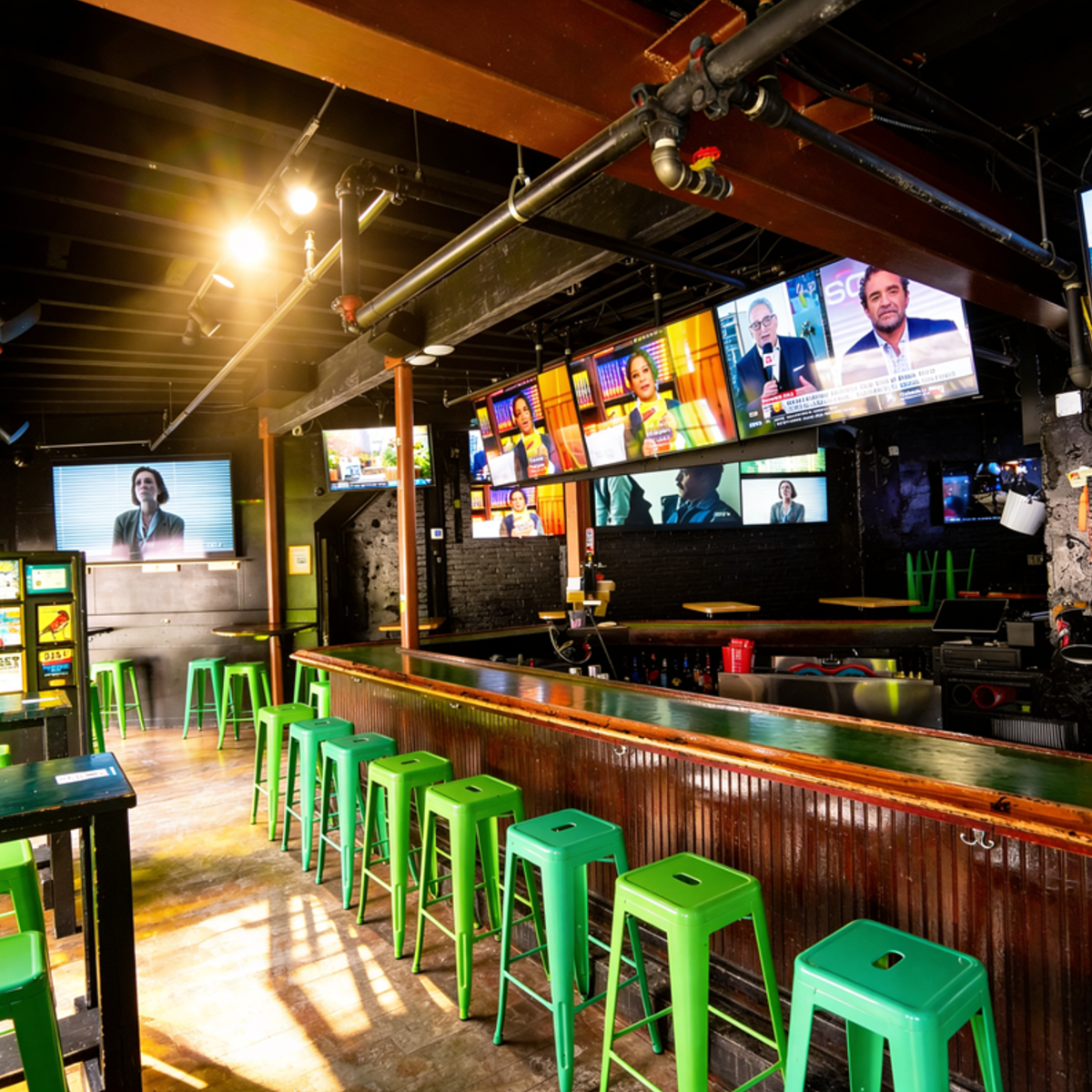
A sports bar AV system is not a collection of devices. It’s an ecosystem—network infrastructure, power distribution, thermal management, acoustic design, content routing, control interface, low voltage lighting, and ongoing support—all engineered to work together under real-world conditions. Removing any piece of that ecosystem creates a single point of failure that the rest of the hardware can’t compensate for.
What a Professionally Designed System Accounts For
Acoustic zone design
Research shows that 68% of adults find loud dining environments annoying, and 64.8% say they’d actively avoid a noisy restaurant. In a sports bar, the challenge is more nuanced: you need the main viewing area to feel electric and immersive while keeping the dining section, patio, and bar top at independent volume levels that encourage guests to stay longer and spend more.
Studies have shown that environment design—specifically, audio tempo and volume—can extend average guest stays from 57 minutes to 80 minutes. That’s 23 additional minutes of potential revenue per table, per turn. A plug-and-play kit gives you speakers. A designed system gives you zones that drive revenue.
Daypart programming
A sports bar isn’t the same room at lunch, happy hour, and prime time. The AV system needs to shift seamlessly between background music for the lunch crowd, multi-game presentation for happy hour, and full-immersion mode for the main event. Your staff needs to make those transitions with a single button press, not a 15-step process. In our experience building commercial AV systems for high-volume venues, daypart automation is the difference between a system staff loves and a system staff works around.
Scalability without rewiring
AV over IP is the right technology for modern sports bar distribution, but only when deployed on a properly designed network with room to grow. Adding screens for a patio expansion, a new private event space, or a seasonal outdoor viewing area should mean plugging in another decoder, not ripping out infrastructure. The AV Access 4KIP200 and WyreStorm NetworkHD systems both use IP-based distribution, which is genuinely scalable, but only on a network that was designed for it from the beginning.
Ongoing support and optimization
According to AVIXA, the commercial AV industry’s shift toward managed services reflects a fundamental truth: installation is the beginning of the system lifecycle, not the end. When something goes wrong at 9 PM on a Saturday during a World Cup quarterfinal, you need a partner who answers the phone, not a manufacturer’s support ticket queue with a 48-hour SLA.
Words from Crunchy Tech’s Engineering Team:
“We’ve built both kinds of systems: the ones that work and the ones that become $40,000 problems hiding behind a remote control. The difference is always whether AV was treated as a strategic investment or an afterthought.“
The Design-Build Difference: Why the Process Matters More Than the Product
Crunchy Tech’s Design-Build methodology exists precisely because the AV industry has a trust problem. Too many bar owners have paid for systems that looked impressive on a quote and underdelivered on the floor. The plug-and-play trend is a symptom of that distrust, and we understand why it’s tempting.
But the answer to bad integration isn’t no integration. It’s better integration.
How Design-Build Works
Phase 1 buys clarity.
Before any equipment is specified, the design team assesses your space, operations, peak demand scenarios, and revenue goals. You see not a generic diagram, but the system visualized in your actual venue. You understand exactly what you’re getting and why. This phase alone eliminates the most expensive mistake in AV: buying the wrong system for the wrong reasons.
Phase 2 buys certainty.
Equipment is specified based on what the space needs to accomplish. It’s not based on what’s in stock or what carries the highest margin. You choose from value, balanced, and premium options with clear tradeoffs. The network is designed. The power is planned. The acoustic zones are mapped. The control interface is built for your staff. And when install day arrives, there are no surprises.
After install, the partnership continues.
Crunchy Tech provides ongoing support, system optimization, and the ability to scale as your venue evolves. Adding screens for the World Cup? Expanding to a rooftop bar? Upgrading to a video wall? The system was designed to accommodate growth from day one.
Across 17 years, 300+ technical experts, and projects spanning 32+ cities in 15+ states, Crunchy Tech has designed and built AV systems for some of the most demanding hospitality environments in the country, including multi-location sports bar brands, national restaurant groups, and high-volume entertainment venues that can’t afford “good enough.”
The Bottom Line
The plug-and-play AV trend isn’t going away, and for simple applications, it has a place. But a World Cup-ready sports bar isn’t a simple application. It’s a high-demand, high-stakes commercial environment where the AV system directly impacts revenue, guest experience, and competitive position.
Before you compare bids, compare outcomes. The low bid is only cheaper on install day. After that, the room has to earn its keep.
Ready to see what your space could do for the 2026 World Cup? Get a free site assessment from Crunchy Tech and let’s have a conversation about what’s possible.

Frequently Asked Questions
What is a plug-and-play AV system for sports bars?
A plug-and-play AV system is a pre-packaged kit of encoders, decoders, matrix switchers, and sometimes a control app designed to be self-installed by bar owners without professional integration. Companies like AV Access, WyreStorm, Octava, and SportsBar-TV Systems market these packages as turnkey solutions. While they can work for basic setups with a few screens, they typically lack the network design, acoustic planning, thermal management, and ongoing support that commercial sports bar environments require during peak demand.
How much does a sports bar AV system cost for the 2026 World Cup?
Costs vary significantly based on venue size, number of displays, audio zone requirements, system complexity, etc. Pre-packaged plug-and-play kits can range from $5,000 to $20,000, while professionally designed and installed commercial AV systems for sports bars typically range from $25,000 to $150,000 or more. The critical distinction is the total cost of ownership, including reliability during peak events, staff usability, scalability, and long-term support.
Why can’t I just install a plug-and-play AV system myself?
You can—for a basic setup with a handful of screens and a single audio zone. The challenge arises when you need 20+ displays across multiple zones, independent audio control, daypart automation, and a system that operates reliably when 200 fans pack your bar for a World Cup knockout match. Commercial AV requires network infrastructure design, dedicated electrical circuits, thermal management for equipment racks, and a control interface your staff can operate under pressure.
What is AV over IP and why does it matter for sports bars?
AV over IP distributes video and audio signals across standard network infrastructure as opposed to through dedicated HDMI cables. This is the technology most modern sports bar AV systems are built on. The advantage is scalability: adding a screen means adding a decoder to the network, not running new cable. The catch is that the network itself must be professionally designed with sufficient bandwidth, proper VLAN segmentation, and adequate PoE power budgets.
How far in advance should I upgrade my sports bar AV system before the 2026 World Cup?
Professional AV integration projects for sports bars generally take 4 to 12 weeks from initial design through final commissioning. Factor in equipment lead times and the likelihood that demand for AV services will spike as the tournament approaches. A Design-Build process begins with a site assessment that creates clarity before any money is committed to hardware. Start the conversation now.
References & Sources
2. Micronomics FIFA World Cup 2026 Economic Impact Report
3. FIFA & WTO World Cup 2026 Economic Study
4. IBTimes – 2026 World Cup Economic Impact on Global Football Economics
5. AV Access 4KIP200 Product Page
6. WyreStorm NetworkHD Product Line