
An outdoor video wall usually starts as a simple idea: a bigger, brighter way to reach people walking or driving past. The quotes that come back rarely look simple. Two walls of the same size can land far apart in price, and the spec sheets behind them are full of terms like nits, IP65 and pixel pitch that don’t explain what you’re paying for.
Most of that spread comes down to a handful of decisions, and each one ties back to how the wall will be used. Outdoor walls also face problems indoor screens never do. Direct sun washes out ordinary displays, and many cities limit how bright a sign can be after dark. This guide walks through the four spec decisions that shape an outdoor LED video wall, then the cost drivers and the questions to ask before you sign.
Start With What the Wall Has to Do
Every spec decision downstream depends on the job you’re hiring the wall to do. A wall selling promotions to drivers along a highway frontage needs extreme brightness and can use coarse resolution, because people read it from hundreds of feet away. A campus wayfinding display, one of the most common forms of outdoor digital signage, has to be legible from a few steps away and can run at lower brightness under a canopy.
Advertisers are moving in the same direction. According to the Out of Home Advertising Association of America, U.S. out of home advertising revenue reached a record $9.46 billion in 2025, and digital formats made up 36.3% of it while growing 10.5% year over year. For a business, the takeaway is practical. A wall only earns that kind of attention if it’s readable and current, and the four decisions below determine both.
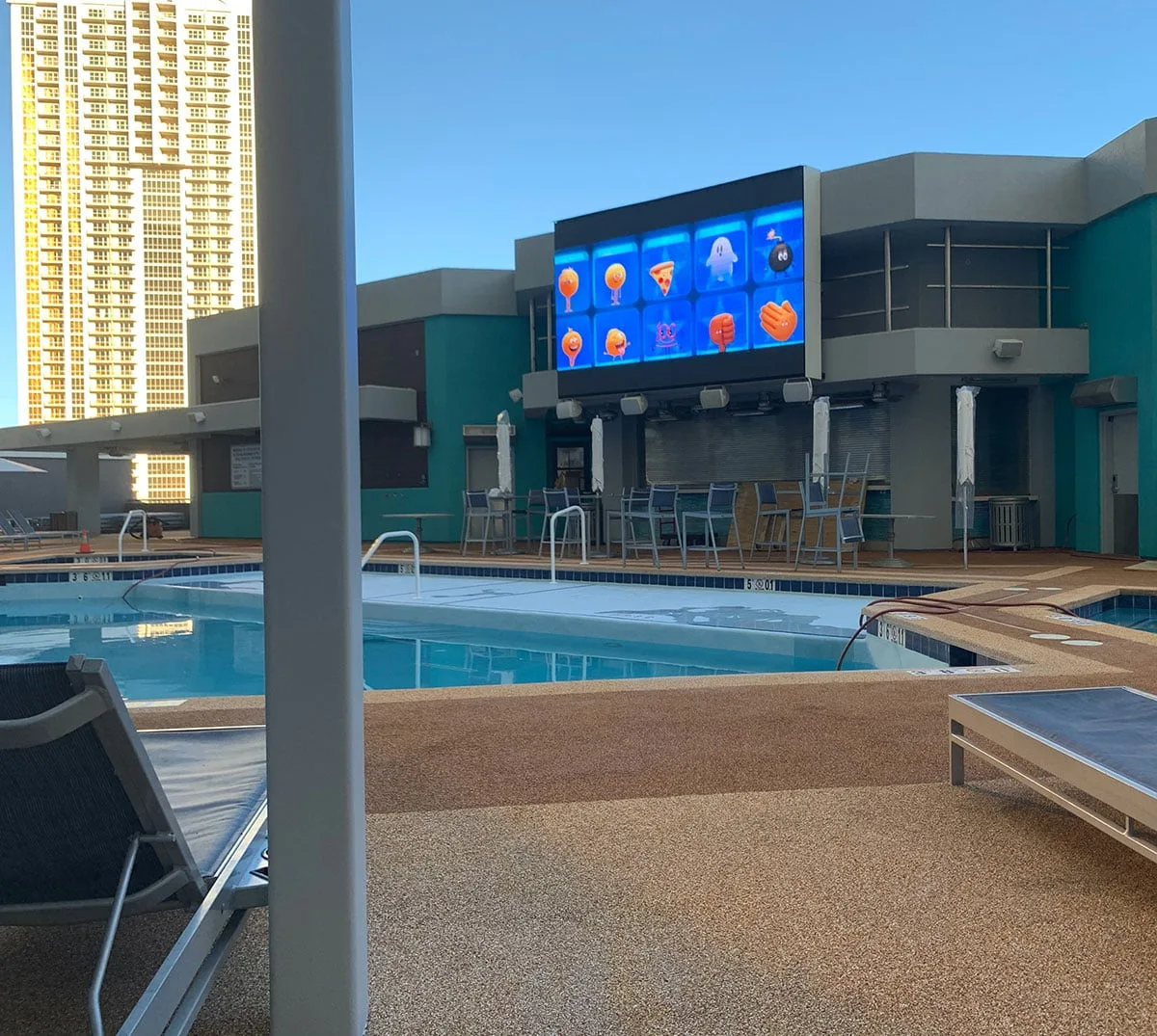
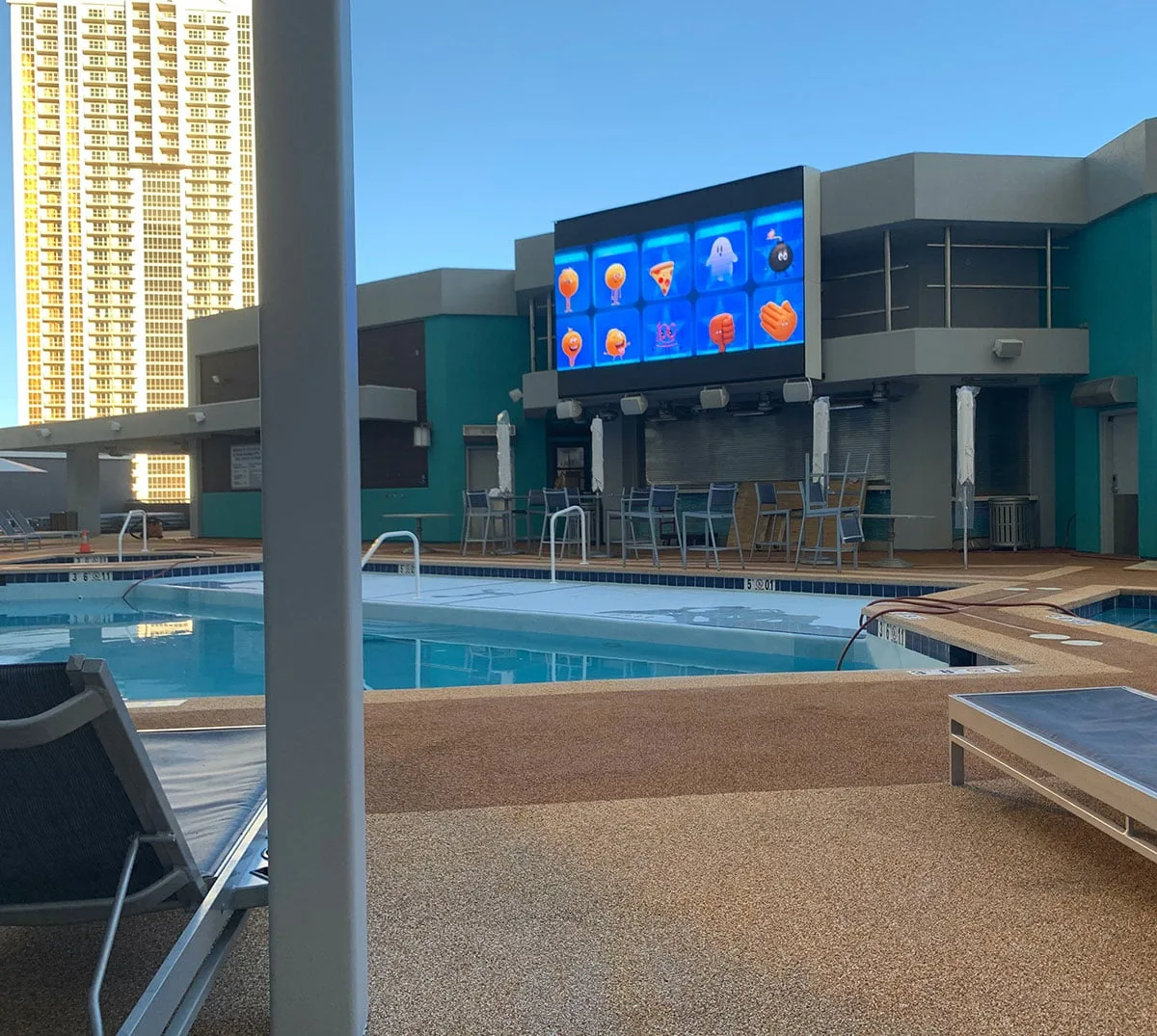
The same holds on private property. On a resort pool deck we built for Marriott Vacations Worldwide, an IP65-rated, 16-by-9-foot curved LED wall on a hurricane-rated structure carries movies and live sports, and pool bar sales rose 40% after installation.
Brightness
Brightness decides whether anyone can see the wall at noon. Indoor LCD displays typically produce 300 to 700 nits (a nit is a standard unit of screen brightness), which direct sunlight overwhelms. Outdoor LED walls generally run from about 3,000 nits for shaded sites to 7,500 nits or more for full sun. One reseller’s guidance on Planar’s outdoor lines matches about 3,000 nits to shaded plazas and close viewing, and about 7,500 nits to south-facing billboards.
Night brings the opposite problem. A wall bright enough for noon is glaring after dark, so outdoor walls use ambient light sensors that dim the display as daylight fades. The Out of Home Advertising Association of America (OAAA) recommends that digital signs stay within 0.3 foot-candles above ambient light at night. States including Colorado and Michigan have written that standard into law, and many cities and counties use it in their sign codes. Before you buy, ask your city’s planning or zoning office which brightness and permit rules apply to your site.
Weatherproofing
Outdoor panels need protection from rain and dust, and the spec that shows it is the IP (ingress protection) rating. Outdoor LED installations are typically rated IP65 or higher, meaning the panels are dust-tight and protected against jets of water. Ask whether the rating covers both the front and back of the cabinet, especially if the back of the wall will be exposed.
Heat is the less obvious threat. Panels generate their own heat on top of the sun’s, so cabinet design and ventilation deserve as much attention as the rating. The mounting structure also has to be engineered for local wind loads, and your city may review it as part of the sign permit.
Weather-rated doesn’t mean maintenance-free. Seals and power supplies age faster outdoors, and a preventative maintenance plan catches small failures before they show up as dark patches on the screen.
Size and Viewing Distance
Pixel pitch, the distance in millimeters between the centers of neighboring LEDs, determines how close someone can stand before the image breaks into dots. Tighter pitch costs more because it takes more LEDs to fill the same area. For reference, one manufacturer rates its 1.6mm outdoor panels for comfortable viewing from about 8 feet and its 2.5mm and 2.9mm panels from about 14 feet. Billboard walls read from across a road use far coarser pitches.
The practical rule is to size the wall from where your audience actually stands. Measure the closest regular viewing spot (a patio table or a drive lane) and the farthest. A pitch finer than your closest viewer can see adds cost without adding value, and that money is usually better spent on brightness or a larger canvas. Because LED video walls are built from modular cabinets, the finished size and shape can follow the site instead of a standard screen size.
Control and Content
A wall that’s hard to update ends up running last season’s promotion. Many outdoor walls today connect to a cloud-based content management system (CMS), so staff can schedule and change content from a browser instead of plugging into hardware on site. Scheduling by time of day is worth setting up from the start, with a lunch special at noon and event listings in the evening.
Behind the CMS sits the LED processor, the unit that maps content across the cabinets. It usually lives indoors, sometimes far from the wall, with fiber carrying the signal over long distances. Plan that cable path early, since trenching or new conduit can add real cost.
Monitoring closes the loop. Ask whether the system reports faults automatically and who responds when it does. Settle that before installation, including what’s covered under a support plan.
What Drives the Cost of an Outdoor Video Wall
Two outdoor walls of the same size can be priced far apart, and the gap usually traces back to a few line items:
-
Pixel pitch. Finer pitch means more LEDs per square foot and a higher panel cost.
-
Brightness rating. Panels built for full sun cost more than models for shaded sites.
-
Structure and mounting. Freestanding walls and building facades need engineered steel and sometimes new foundations.
-
Power and data. New electrical circuits and fiber runs often surprise buyers, especially when trenching is involved.
-
Permits and engineering. Sign permits and structural review add fees and time to the schedule.
-
Support after installation. Monitoring and maintenance are ongoing costs worth budgeting from day one.
Site conditions decide many of those line items, which is why AV quotes take time when they’re done right. A fast quote that skips the site survey usually means change orders later.
Questions to Ask Before You Sign
-
What brightness are the panels rated for, and how does the wall dim at night?
-
What IP rating do the cabinets carry, front and back?
-
What pixel pitch are you recommending, and why that pitch for my viewing distance?
-
Who handles sign permits and structural engineering?
-
How will my staff update content, and who trains them?
-
Does the system report faults automatically, and who responds?
-
What maintenance does the wall need each year, and what does it cost?
If an integrator can’t answer these clearly, keep looking. Our design-build process works through each one with you before installation. When you’re ready to plan yours, talk with our team.