Just do it. Spend the money. It’s well worth it. It’s not worth your time, hassle, energy, and stress of trying to make it look right and do it right when there’s somebody who has been doing it for years and has perfected the craft.
Restaurant AV in Myrtle Beach
Restaurant sound systems built to survive a compressed season, with marine-grade hardware, a serviceable rack, and a commissioning check before the year's busiest weeks.
Downtime in July is not recoverable
A Grand Strand restaurant does most of its year in a handful of weeks. That changes what a failure costs. In a market with steady trade, a dead speaker zone on a Friday is an annoyance you fix Monday. Here, a Friday in July is a meaningful slice of the annual number, and the same fault sits in front of a full house that will not come back next week. Then it repeats through the weekend, because the part is not local, the system was never documented, and the technician who installed it is somewhere else in season.
So the design brief is different from an ordinary restaurant. Equipment gets specified for the environment it actually sits in rather than the one on the datasheet, since salt air and constant humidity age hardware here faster than almost anywhere else. The rack gets built to be worked on quickly by someone who has never seen it, with everything labeled at both ends and documented on site. And the whole system gets a commissioning check before the season starts, so the faults that would have surfaced in July surface in April instead, when a slow Tuesday is the worst it costs you.

Restaurant AV Along the Grand Strand
From Ocean Boulevard and Broadway at the Beach to Murrells Inlet, North Myrtle, and the inland communities, we design restaurant sound systems built to get through the season without a call.
Salt corrodes grilles, connectors, and mounting hardware, so everything exposed gets marine-grade specification down to the fasteners and the cable.
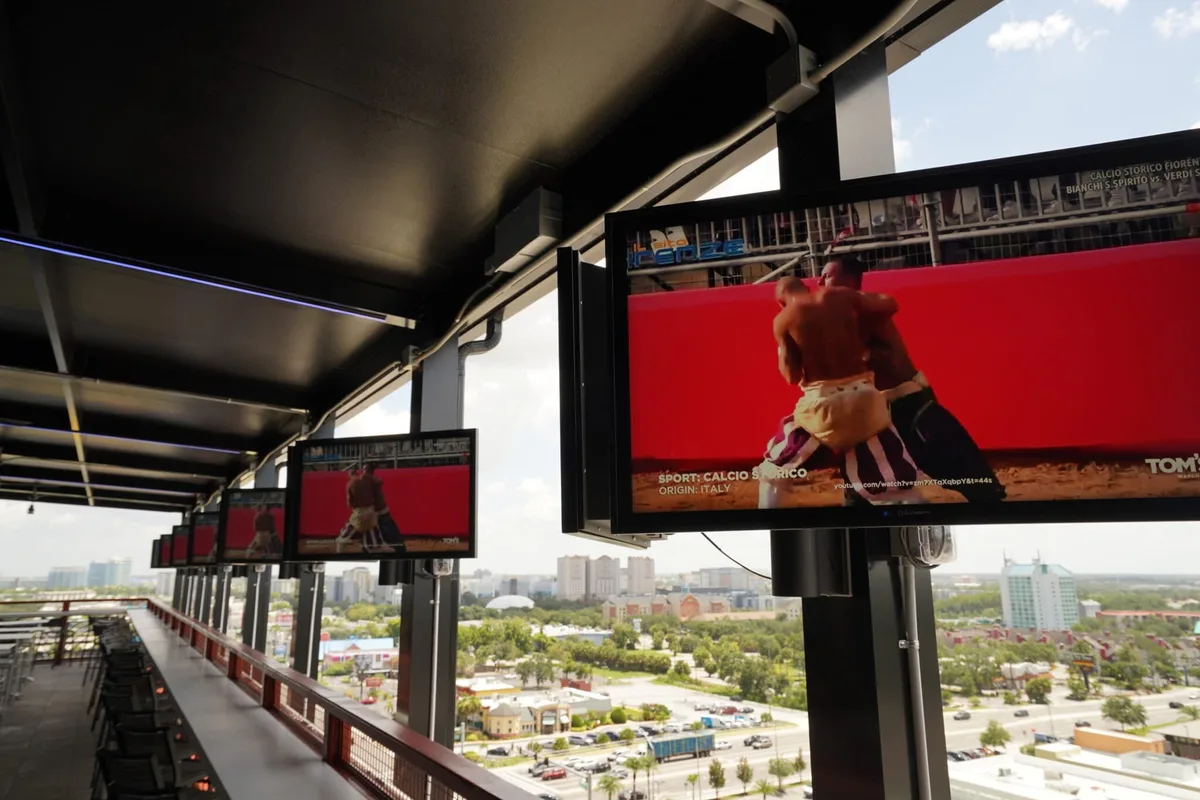
Outdoor displays run high brightness with ambient sensing, and exposed materials get selected to hold up under constant UV.
Wind and water drive rack placement and mounting, so equipment sits protected inside the conditioned envelope with surge protection specified.
Moisture forms inside enclosures, so outdoor gear gets sealed and drained properly instead of coated and hoped over.
How we work
Built to be fixed fast before the season starts
We do not start with a speaker count. We start with what happens when something fails during your busiest week, because that is the risk this market actually carries.
The consult and the site walk
Most disappointing dining rooms were quoted off a floor plan by someone who never sat in them during service. So we start with a consult rather than a quote: what you want the room to feel like, how big it is, what it needs to do, and the budget you are working with. Then we walk it, ideally in season during a real service, and listen from the places guests actually sit. On the Strand we also look at where the equipment lives, how exposed the outdoor runs are, and what a technician arriving cold would have to work out before touching anything.
Design you can see, then one team on site
The other way these go wrong is that nobody experiences the outcome until it is built, then wants it changed a season later. So you see the design before you commit to equipment, including where every speaker lands and why the outdoor selection costs what it does. Control gets programmed around the states you actually run, so a packed July Saturday, a quiet February afternoon, and a rainy night are presets rather than a training problem for a crew hired in May. One team handles the install, calibration, staff training, and documentation, and coordinates with your general contractor, electrician, and low-voltage trades.
What we build
The restaurant AV stack a Grand Strand room runs on
A dining room and a deck are a handful of systems working as one, and on the coast every one of them is exposed to something. Here is what we design, program, and install.
Multi-zone sound, indoors and on the deck
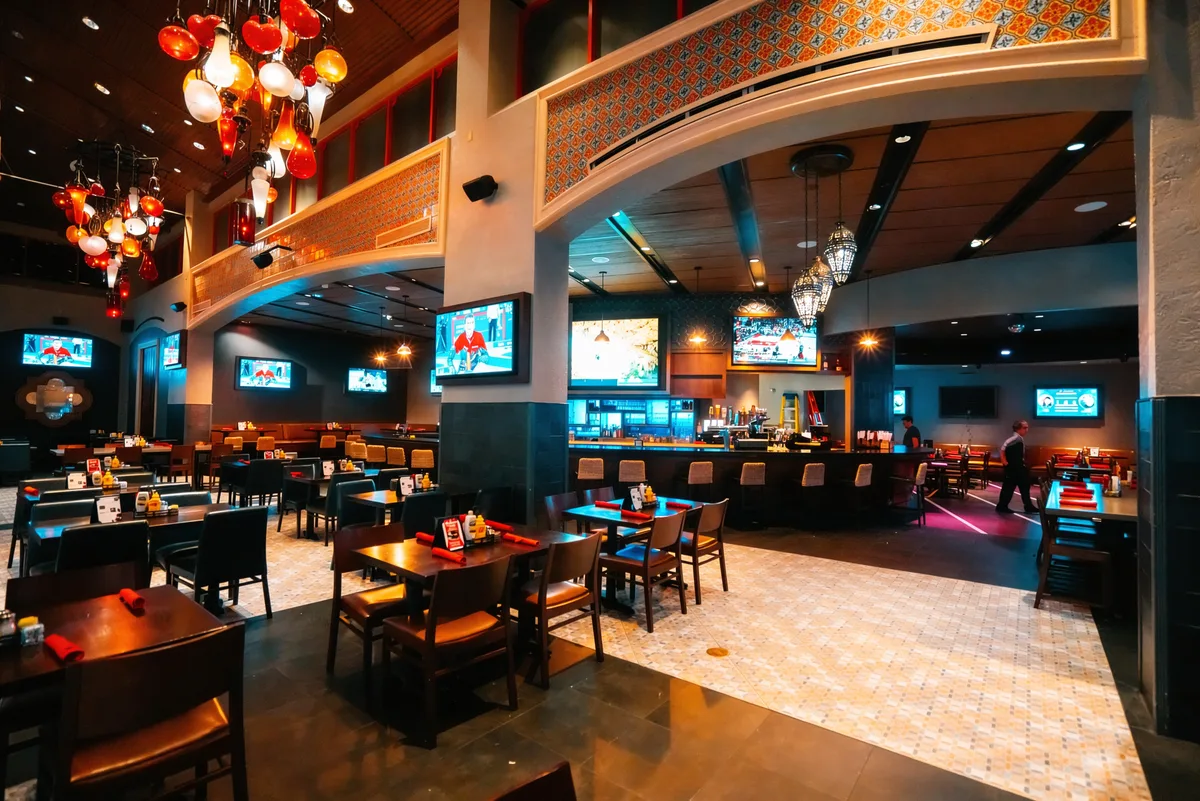
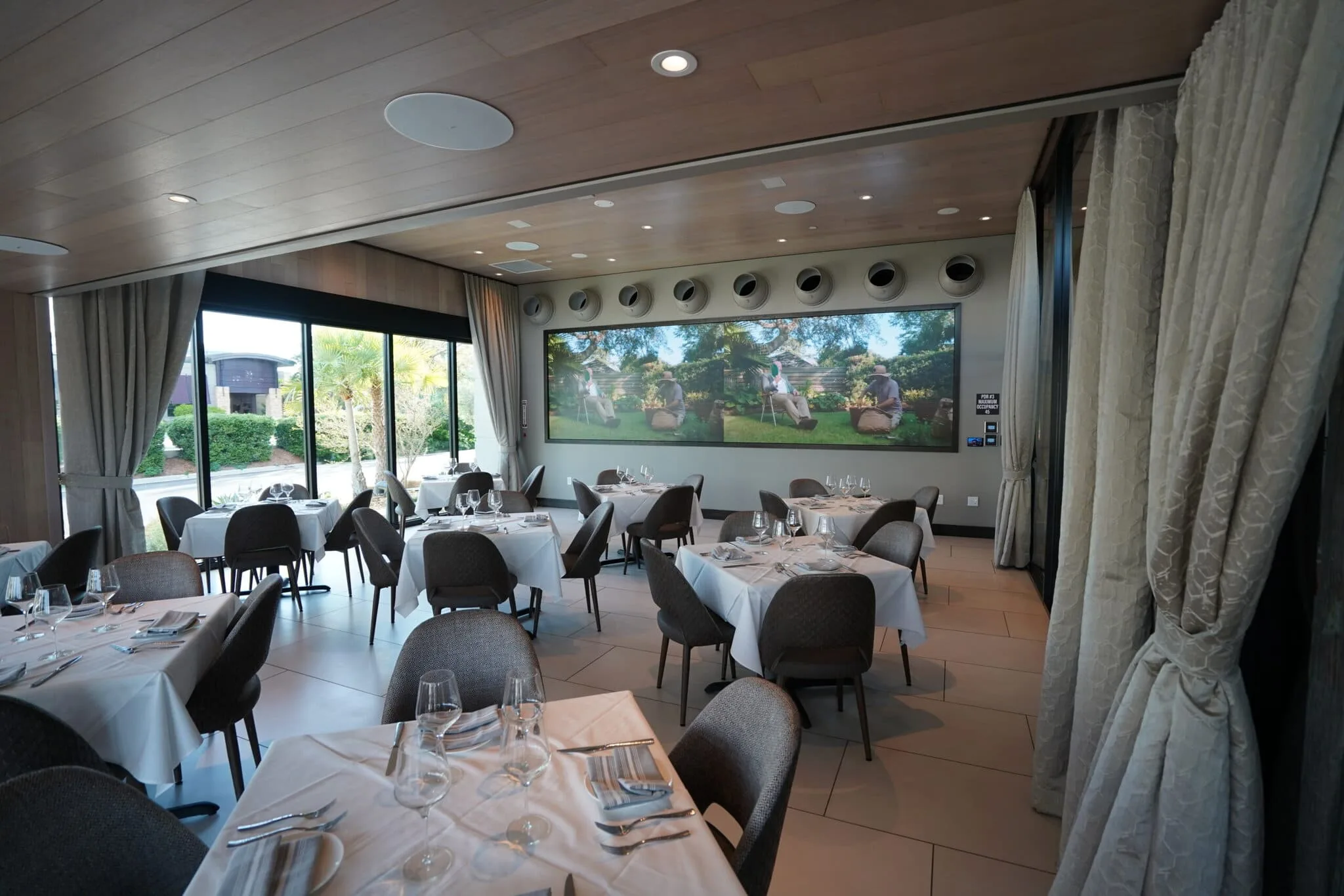
Coverage comes first. More sources at lower level, placed so every table sits inside a pattern rather than under one or between two, is what makes a room comfortable to eat in, and it has a reliability benefit here: a system that is never asked to work hard runs cooler and lasts longer. The failure we walk into most often is speakers run around the perimeter, which leaves the middle with nothing while punishing anyone against a wall. Outside, open air returns nothing, so the deck gets a higher count spread across it at a moderate level, on its own zone with its own limit.
Hardware specified for salt and season
Selection is where most of the reliability is won or lost. Salt air attacks grilles, drivers, connectors, and especially mounting hardware, which fails as often as the speakers do and is usually the part nobody specified. So everything exposed gets marine-grade selection down to the fasteners and the cable, and outdoor displays get sealed enclosures with their own thermal management rather than a consumer panel under an awning. The other factor is duty cycle: a room open sixteen hours a day for fourteen weeks asks far more of a system than the same room in a year-round market, so the components get sized with margin.
A rack a stranger can work in
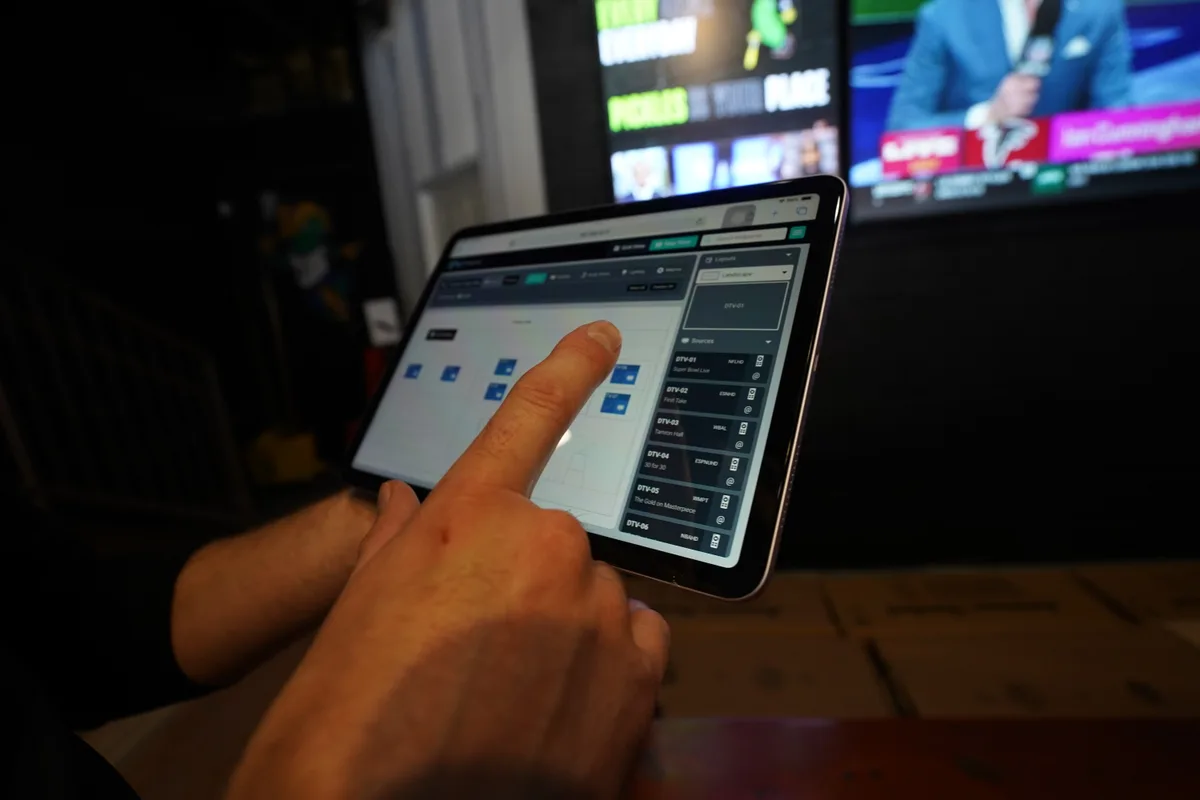
The part that decides how long an outage lasts is the part nobody looks at. Equipment lives in one enclosed rack with every cable labeled at both ends, power separated from audio and data, a clean layout, and current documentation kept on site rather than in somebody's email. That way a fault gets diagnosed by looking rather than by tracing, and often without a site visit at all, since a dedicated AV network and consistent naming let a lot of problems be found remotely. Menu boards and levels run on a schedule, and the settings that took a designer to establish sit behind credentials so a new hire cannot undo them.
Why Grand Strand restaurants trust us with it
Built for a compressed season in salt air
This market runs its systems harder, for a shorter window, in a harsher environment than most. Here is where our depth shows, and where our scope ends.
Find it in April, not in July
Almost every in-season emergency we get called to was visible months earlier. A corroded connector that was still passing signal, a speaker already failing at one end of a run, a rack quietly running ten degrees too warm. So the useful habit in a seasonal market is a commissioning check before the season rather than a service call during it: levels verified, outdoor runs inspected, connections checked, the rack cleaned and its temperature confirmed, and anything marginal replaced while replacing it costs almost nothing. It is the single cheapest thing an operator here can do, and it is the one most often skipped.
Salt, sun, and duty cycle
Three coastal realities shape the build. Salt air corrodes anything unprotected, so exposed hardware gets marine-grade specification and mounting gets chosen to match rather than being an afterthought. Sun crosses the decks all afternoon, so outdoor displays need real brightness with ambient sensing and exposed materials get selected for UV. And the season itself is a stress test, since a system running sixteen hours a day for fourteen weeks accumulates more use than a year-round room does in months. Keep the equipment room at or below 75 degrees, because temperature is the single most expensive variable in how long a system lasts.
Support after opening night
Crunchy Tech started in 2008 as an AV support operation, which is an unusual origin for an integrator and the reason the systems get built the way they do. When you spend years fixing other people's work, you learn exactly where installations cut corners. That shows up in a rack you can actually service: fully enclosed, every cable labeled at both ends, power separated from audio and data. We have opened racks that looked fifteen years old after three months in an uncooled closet, with dust caked on every surface. Around 47 percent of support tickets close inside an hour and roughly 72 percent within a day, and that number is mostly a function of how the system was built.
Where we draw the line
We do not install or operate cameras, we do not produce or edit video, and we do not run streaming as a service. We are not acousticians, and where a room's loudness is the surfaces rather than the system we will say so. We also generally do not take install-only work. If you already bought equipment we will look at it, but we need to understand the design first, and we will not put our name on consumer-grade speakers on an open deck in a salt-air climate, because we will be the ones getting the call in July.
What it earns back
How reliability pays for itself in one weekend
In a compressed season the return on a properly built system is not incremental. It is the difference between a peak weekend that ran and one that did not.
The Saturday that did not go wrong
A dead zone on a July Saturday costs more than the equipment that failed. It costs the covers you turned slower, the deck you could not sell properly, and the reviews written by people who will not be back to give you another impression. Across a peak weekend that number gets large quickly. On the ordinary side the arithmetic is the same as anywhere: guests who cannot hear each other eat, decline dessert, and go, and the check closes early. The difference here is that it is concentrated into the weeks you cannot afford to have it happen in.
Good, Better, Best against one design
Most owners price AV like retail: a speaker costs a certain amount, so a room of speakers should not cost much more. Worth being plain about the gap, because the processor, the amplification, the cabling, and the control take a serious share of the budget before you buy a single speaker, and marine-grade outdoor hardware costs more than the indoor equivalent for good reason. So we quote Good, Better, and Best against one design, per zone. Good is a real recommendation, not a strawman: even coverage, separate indoor and deck zones, presets, and a rack built to be serviced. If your budget is short of the room, we would rather value engineer it honestly than sell you hardware that fails in a season.
Something always fails in the middle of the season. How do we stop that?
By finding it in April, because almost every in-season emergency we get called to was visible months earlier. A connector that has started to corrode but is still passing signal, one speaker in a run already down, a rack sitting ten degrees warmer than it should. None of that announces itself, and all of it turns into a failure once the system is running sixteen hours a day in July. So the useful habit here is a commissioning check before the season rather than a service call during it: levels verified, outdoor runs inspected end to end, connections checked, the rack cleaned and its temperature confirmed, and anything marginal replaced while replacing it is cheap. The second half is how the system was built in the first place, since a labeled, documented, enclosed rack on a dedicated network means a fault that does happen gets found quickly rather than traced.
Our outdoor speakers do not last. Is that just the coast?
It is the coast plus the specification, and the specification is the part you control. Salt air attacks grilles, driver surrounds, connectors, and mounting hardware continuously, and hardware rated for a mild outdoor climate is not rated for that. The brackets are the most overlooked component and they fail as often as the speakers, usually because they were the one item nobody specified. So marine-grade selection has to run through everything exposed, including the fasteners and the cable, with placement that keeps components out of direct spray where the layout allows. The other half is duty cycle. A deck system running sixteen hours a day through the season accumulates more use in fourteen weeks than a year-round room does in months, so components get sized with margin rather than to the minimum that works on opening day.
How quickly can something get fixed if it does break during peak?
That depends almost entirely on how the system was built, which is why we treat serviceability as a design requirement here rather than a nice-to-have. A rack that is enclosed and labeled at both ends, with power separated from audio and data, a clean layout, and current documentation kept on site means a technician arriving cold can diagnose by looking rather than by tracing. A dedicated AV network with consistent naming means a good share of faults can be identified remotely before anyone drives, and settings problems, which are the most common call anywhere, often get resolved without a visit at all. Around 47 percent of our support tickets close inside an hour and roughly 72 percent within a day. What genuinely needs someone on site is physical: a failed speaker, a corroded outdoor run, storm damage. Those are the ones a pre-season check is designed to catch.
Do you handle cameras, livestreaming, or video production?
No. We are a design-build AV integrator. We do not install or operate cameras, we do not shoot or edit video, and we do not run streaming as a service. What we do is design the system around how the restaurant actually runs, procure the hardware, install it, calibrate it, train your staff, document all of it, and support it for the life of the system. Where a venue works with a production partner, we build the infrastructure that makes their job easy: clean audio feeds, documented signal paths, and a network engineered for the uplink. The content side belongs to specialists.
What We Do Here
Services available in Myrtle Beach
Every system is designed, installed, and supported by our own team in Myrtle Beach — never subcontracted.
AV Consulting
AV consulting from an audio visual consultant who joins at the architectural phase, designs the technology into the plan and steers the project around your business outcome.
AV Consulting in Myrtle Beacharrow_forwardVideo Wall Solutions
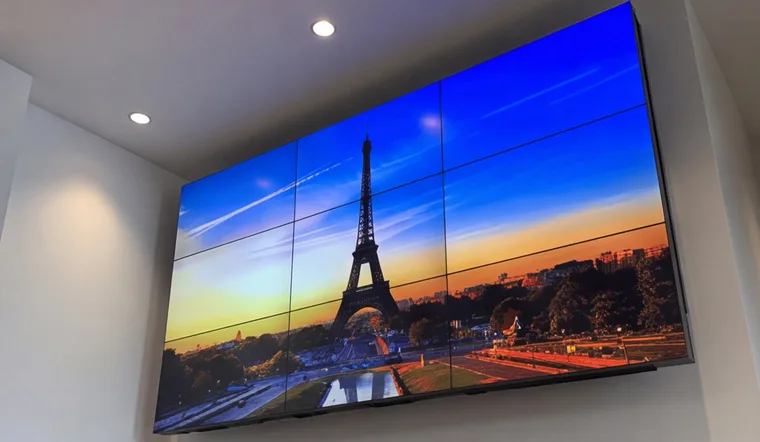
Commercial video walls across LED, LCD and Direct View. Designed, integrated, installed and supported by a national design-build AV integrator.
Video Wall Solutions in Myrtle Beacharrow_forwardDigital Signage Services
Design-build digital signage for hospitality and enterprise: commercial displays, content management, and installation that keeps your screens selling and current.
Digital Signage Services in Myrtle Beacharrow_forwardLearn more about our Restaurant AV Systems solutions
Operators who run on our systems
Client successes drive Crunchy Tech to become better. Below is how our customers feel about us.
Working with Crunchy Tech was a fantastic experience from start to finish. They handled the sale and installation of all our sound and TV equipment at The County Bar in Aviston, IL, and absolutely nailed it. We were on a very tight deadline, and they not only met it—they delivered top-notch quality and service the entire way. Highly professional, responsive, and easy to work with. We couldn't be happier with the results.
Crunchy has done an amazing job on our A/V install. The sound is perfectly balanced throughout our many zones and the entire system is super simple to use.
Just do it. Spend the money. It’s well worth it. It’s not worth your time, hassle, energy, and stress of trying to make it look right and do it right when there’s somebody who has been doing it for years and has perfected the craft.
Working with Crunchy Tech was a fantastic experience from start to finish. They handled the sale and installation of all our sound and TV equipment at The County Bar in Aviston, IL, and absolutely nailed it. We were on a very tight deadline, and they not only met it—they delivered top-notch quality and service the entire way. Highly professional, responsive, and easy to work with. We couldn't be happier with the results.
Crunchy has done an amazing job on our A/V install. The sound is perfectly balanced throughout our many zones and the entire system is super simple to use.
Insights
Let's get you through the season without a call
Tell us about the restaurant: where you are on the Strand, the square footage, how much of your seating is exposed, what has failed on you in season before, where the equipment lives, and how your staffing changes through the year. We will start with a consult to understand what you are trying to accomplish, then walk the property in daylight and again during a real service, and come back with one engineered recommendation instead of a parts list.
- Marine-grade hardware through everything exposed, including the brackets and the cable.
- Components sized with margin for a system that runs sixteen hours a day in season.
- A rack labeled, documented, and laid out so a technician arriving cold can diagnose by looking.
- A commissioning check before the season, so faults surface in April rather than July.